About this blog . . .

This blog is about 80% journal, 20% review. These posts may describe very recent visits or visits taking place in the last 3 or 4 years--please feel free to update or correct any of my information in the comments or through an email message.

Saturday, October 6, 2012

Experience Music Project (The EMP Museum), Seattle

         
The Experience Music Project at the Seattle Center opened in  2000 and still seems to be working on defining its mission.  Conceived and financed by Microsoft billionaire Paul Allen,  it boasts the sophistication in its exhibits and design expected from a much larger non-profit foundation.  The building, designed by the unmistakable hand of Frank Gehry, sports the usual foil curves and ripples of a Gehry building, and for a popular culture oriented museum in an arts district, the form works well.

For a tourist, the introduction to the museum is a bit confusing.  One guidebook in our hotel room mentioned a "Science Fiction" museum, which piqued my interest.  Another online source mentioned, by name, the "Experience Music Project," which also seemed worth a visit.  It wasn't until we arrived and looked around the area that we realized they were both the same museum after a few makeovers.  According to Wikipedia, in fact, the EMP has undergone more than one change in focus--presumably reflecting the decisions of its founder.

Despite the confusion, the Project itself is well worth the experience.  The entrance opens into a darkened "Sky Church," a large, dark, open room with a viewing screen several stories high and several lounge-type chairs scattered throughout.  The screen was playing Hendrix's performance of the national anthem when we first arrived.

From the Sky Church, visitors enter the main foyer area, dominated by If VI Was X: Roots and Branches, an enormous tower which, according to the display sign, "is composed of nearly 700 instruments...which perform a series of Trimpin's compositions expressive of the roots of American popular music."  Along with several other guests, I spent a good deal of time trying to find a way to photograph the sculpture; I finally took the lead of another visitor who laid down on the floor a few feet away and pointed her camera upwards.  Another gave up trying to get a good view in a still camera, and took a video sweep.   Later in the visit, I found a much better vantage point from a higher floor.


From Nirvana Exhibit


The museum's starting point for exhibits is Seattle native Jimi Hendricks; one of the first exhibit hallways features his work.  Costumes, instruments, personal letters, and even a yearbook from Hendricks's school days fill out this section.  Washington state natives Nirvana also feature in a prominent exhibit, including the usual guitars, album covers, personal letters, and taped interviews.


My favorite exhibit was probably the guitar room.  Display cases here followed the history and evolution of the electric guitar, and a continuing looping video--about 20 minutes long--ran through a sampling of dozens of distinctive guitar stylists.  The samples ran the gamut from Les Paul and Mary Ford to Jeff Beck and Eric Clapton, Andres Segovia, Bonnie Raitt, Chet Atkins, Albert King, and about a dozen more.  It was interesting to see the range of styles, and to see the inclusion of early female artists such as Mary Osborne.  I spent a good 40 minutes here looking first at the displays and then watching the film


.In another wing, the Science Fiction incarnation of the museum takes shape.  The definition of Science Fiction, apparently, included  Horror Films, and a slick, often interactive section brings visitors through theories about the appeal of horror and observations from directors of horror films.  Vintage posters decorate one wall, and cases display famous/infamous artifacts from classic horror films, including the creature from Alien and various axes and weaponry.  Another case holds one of the costumes from Michael Jackson's "Killer" video, and an interactive display uses shadows and light to show visitors how their own silhouettes can be transformed into frightening shapes.  I'll have to say that I'm not a fan of this genre, but the exhibit was fun and interesting.


In May of 2012, an extensive exhibit based on Avatar represented most of the Science Fiction aspect.   Most of this entire section was interactive.  One station allowed visitors to create their own plant life for the Pandora; others allowed visitors to shoot film with robotic characters.  Lighting and music enhanced the effect.


Sound Lab exhibit
Pop Kitchen and Bar
In addition to the permanent and revolving exhibits and displays, the museum features several Community Spaces, including a "Rec Room" downstairs, which provides a space for music education and experimentation.  A Sound Room offers a space for visitors  to try out dozens of electronic instruments and recording techniques, and musicians can even use a recording room to create their own demos, as we noticed at least one aspiring musician doing while we were there.  The Pop Kitchen and Bar near the downstairs entrance completes the museum experience; offering drinks and American cuisine.  We only had coffee, but, as one would expect in Seattle, it was good coffee, and the atmosphere was welcoming.  We would definitely plan our day around a light lunch there if we were to visit again.


From the museum website:

EMP MUSEUM AT SEATTLE CENTER

325 5th Avenue N 
Seattle, WA 98109
Open Daily   10:00am-5:00pm 

Ticket Type
Regular Online
Adults 18-64 $20 $18
Seniors 65+ $17 $17
Students w/ ID $17 $17
Military w/ ID $14 $14
Youth 5-17 $14 $14
0-4


Free


Monday, September 17, 2012

Facebook Page

Just trying out a Facebook page---will have more pictures, less text.

Tuesday, September 4, 2012

Museum Day--September 29th, 2012


 Visit the Smithsonian website to find participating museums and print out tickets for admission.


Tuesday, July 3, 2012

Edgar Allan Poe Museum, Richmond

The Edgar Allan Poe Museum in Richmond, Virginia--not to be confused with the Baltimore Poe Museum and House--is a quirky collection of artifacts presented in a set of buildings described as the oldest house still standing in Richmond, built in 1737.  According to the information on the website, the museum holds the largest collection of Poe artifacts and memorabilia.  The property, alas, was never inhabited by Poe himself, who moved from Boston to Richmond when he was orphaned at the age of three and maintained his connection with the city throughout his life.

The entrance to the museum is the main room of a small house, and it doubles as a gift shop offering books and vintage-style items.  Visitors can take a picture with a cardboard stand-up of Poe here, and then step into an adjoining room with a few artifacts from Poe's young adulthood.

The visit continues out the back door of the first room into a courtyard linked to the other buildings.  One houses material on Poe's younger years, with a timeline displayed over a diorama of the City of Richmond in Poe's day, a re-creation of his childhood bedroom, and information on his family.  The lighting is a little dark, and some of the displays are a little hard to view in the cases provided, but the setting is perhaps appropriate for the topic.  Visitors are provided with a menu-style guide and map, which I found to be a helpful alternative to the usual paper brochure that is folded and unfolded, then discarded after the visit.  The guides are returned at the end of the visit.  No pictures are allowed inside the buildings of the museum, but I wanted to have a reminder of the information in the guide, so I photographed it outside.

The upstairs section of the Exhibit Building seems to be used for meetings and discussion groups and for displaying rotating galleries of Poe-related artwork in the Raven  Room.   When we visited in Spring of 2012, the artist featured was James Carling (1857-87), a pavement artist from Liverpool whose illustrations of "The Raven" resembled modern graphic novel artists' work.  According to the website, Carling's 43 drawing will remain on display until July of 2012.

After visiting the galleries, we stayed for quite a while in the courtyard.  The weather was nice--just finishing a light rain--and benches are provided, making for an enjoyable, quiet place to rest   We also had a view of Poe's bust at the end of the walk in a sort of altar-like structure.

The entire visit took about an hour to an hour and a half.  The museum is near the recently gentrified Shockoe Bottom section of Richmond, so the museum would be a good later afternoon stop before having dinner and going shopping,


From the museum website:

info@poemuseum.org
(804) 648-5523
1-888-21E-APOE

1914-16 E. Main St.
Richmond, VA 23223

Sunday 11:00 A.M. - 5:00 P.M.
Self-guided Tours available. Please call ahead for times of guided tours.
(Gift shop closes at 4:30 P.M.) 


Tuesday - Saturday 10:00 A.M. - 5:00 P.M.
Self-guided Tours available. Please call ahead for times of guided tours.
(Gift shop closes at 4:30 P.M.) 


Monday Closed


Admission
Adults $6.00
Senior Citizens $5.00
Students $5.00

Friday, May 25, 2012

Blue Star Museums

Over 1,500 museums across the United States are offering free admission for active military personnel and families this summer between Memorial Day and Labor Day.  Check the Blue Star Museums website for information on participating museums and an interactive map.


Thursday, May 17, 2012

International Museum Day May 18


The theme for 2012 is "Museums in a Changing World."
Every year since 1977, International Museum Day is held worldwide sometime around 18 May. From America and Oceania to Europe, Asia and Africa, International Museum Day aims to increase public awareness of the role of museums in developing society.

Huffpost LA also has a slideshow of Los Angeles Museums to visit in honor of IMD.

Saturday, May 5, 2012

Presbytere and Cabildo/Louisiana State Museums, New Orleans


The Presbytere and the Cabildo are both part of the Louisiana State Museum.  The two  buildings flank the St. Louis Cathedral at one end of Jackson Square.

The Cabildo--originally a government building for the Spanish colonial administration in the late 18th century --focuses on early New Orleans and Louisiana.  On the ground floor, down the hall from the entry room, two large rooms feature exhibits on Spanish and French Colonial artifacts and information.  Small 2-3 person benches paired with video screens allow visitors to sit and take in short films on episodes in Louisiana history.  Other exhibits display furniture, documents, and other artifacts of early Louisiana.

A large carpeted stairway--decorated with a portrait of famous New Orleans voodoo queen Marie Leveau--leads to the upstairs galleries.  An airy connected hallway overlooks Jackson Square.  Take a few minutes to rest and drink in the view below.  One room--at one point part of the Supreme Court where Plessy v. Ferguson was argued--has more artifacts from earlier centuries, including a death mask of Napoleon Bonaparte.  Another looks at hard times in New Orleans--specifically, the epidemics that plagued all river and port cities in previous centuries.  Information on medicine and funeral rituals completes the experience.


Next door, the early culture of New Orleans is spotlighted, with images of theaters and performance venues and a display of musical instruments, including some hands-on drums visitors can try out. Visitors can follow the Battle of New Orleans through maps and artifacts, including a lock of hair purportedly belonging to Andrew Jackson.

The top floor covers the horrors and hardships of slavery and the effects of the Civil War and Reconstruction on Louisiana.  Letters and diaries, personal narratives, clothing, and other artifacts illustrate the history here.


 The Presbytere continues the story of New Orleans--in particular, the 21st century and Katrina.  The entry room uses indigo lighting to create a somber mood, and Fats Domino's piano--posed in the position in which it was found after Katrina--greets visitors.  Beyond the entry, exhibits cover the science of hurricanes.  One darkened room plays a repeating loop of Katrina footage on a wall-sized screen.  Another features artifacts and stories from the storm--a wall with the distinctive red markings of city inspectors, the handwritten narrative scrawled by a survivor on his wall as he remained trapped in his house, videos of interviews with survivors, and stories of rescuers.


Bottles hanging from ceiling in entry room

Upstairs, the museum shifts into party mode for the Mardi Gras museum.  Besides the obvious--and entrancing--displays of opulent costumes and magnificent images of floats--the museum covers the origins of Mardi Gras in the United States.  One helpful poster explains how to determine Mardi Gras dates each year.  Others discuss the complex culture of Krewes, Kings, and other Mardi Gras traditions.  The museum goes beyond the modern New Orleans version of Mardi Gras to look at folk traditions and Carnival celebrations in rural areas. 


The final touch--restrooms that resemble the port-a-potties on the parade route.


The museums offer a two-fer; admission to both sites for a reduced charge.  Visitors should definitely visit both; I would suggest on consecutive days to avoid museum fatigue.  You'll be in the area every day of your visit anyway--or you should be--so take them both in and steep yourself in New Orleans history from the 1700s to the present.


From the museum website:

The Cabildo and Presbytere

701 and 751 Chartres St., New Orleans LA 70116

Admission--for each museum:
Adults                                                          $6.00
Students, Senior Citizens, Active Military     $5.00
Children 12 and under                                  Free
                   **** 20% discount if tickets for 2 or more museums are purchased.
Hours:  Tuesday-Sunday 10:00 am - 4:30 pm
Closed Monday and state holidays.
 Phone: 504-568-6968
Toll-Free: 1-800-568-6968
Fax: 504-568-4995


Saturday, April 21, 2012

Symposium on Ethnic Museums at the Smithsonian April 25

From the Newsdesk of the Smithsonian Museum:

(Re)Presenting America: The Evolution of Culturally Specific Museums” will address a debate that was reignited in May 2011 when a federal commission recommended establishing a Smithsonian museum dedicated to American Latinos. Critics of “ethnic” museums argue that museums dedicated to the experiences or cultures of specific communities are divisive, while supporters insist that such museums enrich the national narrative and offer more depth and perspective into what it means to be an American.
The event will be held from 9:30 - 5:30 at the National Museum of the American Indian.  There will also be a live webcast for those of us who can't be in D.C.


Tuesday, January 24, 2012

Musical Instrument Museum, Phoenix

Entryway
The Musical Instrument Museum in Phoenix, Arizona left me wishing every city had its own version.  If I lived within driving distance, I would be visiting once or twice a month.  The museum, opened in 2010,  serves as a cultural center for music and music education in the area. If you can only visit once, plan for several hours. Bring a camera (non-flash photography is allowed) and comfortable shoes, and take a break for a meal in the middle of your visit.


Air Guitar!
Like many grand museum projects, the MIM is really too large to experience fully in one visit.  The sheer expanse of instruments and accessories is mind-boggling.  The primary principle of organization is geographic, with wings devoted to different continents and countries.  There is some attention paid to showcasing music by era--turn of the 19th-20th century America in one room, the rock era next door, for example.  There are also some displays that illustrate similar instruments across cultures and time periods.  Visitors can compare bowed strings or percussion instruments, for example.  Near the entrance, an extensive guitar exhibit showcases lutes and guitars from the Middle Ages through modern times, and even includes the ever-popular Air Guitar. 

The museum also displays a few particularly famous instruments, including the piano on which John Lennon composed "Imagine" and one of the giant drums used in the opening ceremonies of the Bejing Olympics.  Using the combination of technology and artifact that informs almost all the museum's displays, the Lennon exhibit provides a looping video of different artists covering "Imagine."
John Lennon wrote "Imagine" working on this piano
Drum from Bejing Olympics


Since sound is even more important here than in other museums, the MIM has pioneered a helpful and relatively easy-to-use listening mechanism.  Visitors don headgear and wear a transmitter that automatically picks up signals from the exhibits themselves. The system works well.  It's easy to forget that the music you're hearing is area-specific;  I found myself startled to lose the music I was enjoying at one station as I drifted towards another.  I also had the strange experience of picking up a strain of music while walking between exhibits, then having to search nearby stations to determine which was producing the music I just heard.


The stations themselves are, for the most part, inventive and interesting. Many rely on recent videos of native musicians playing instruments and seem to have been commissioned for this project.  There are, however, other inventive resources.  The station for Austria, for instance, illustrates traditional Austrian folk dance with a classic clip from The Sound of Music featuring Julie Andrews and Chrisopher Plummer teaching the Laendler to the Von Trapp children.  The Sousa/Band exhibit played an original newsreel of Sousa conducting a military band .


Octobasse
 The Octobasse is a popular spot for pictures.  A full octave lower than a string bass, this instrument was featured in the soundtrack for The Hunger Games.

As intriguing and crucial as the sounds are, the visual elements are also stunning.  The artistry of instrumental design pervades the museum, with intricately carved harps, magnificent bells, and even a Buck Owens flag-design guitar illustrating how artistically beautiful many instruments are to the eye as well as the ear.

Buck Owens' guitar
The Museum also includes an auditorium which is large enough for a decent crowd, yet small enough to foster a sense of intimacy between the audience and the musicians.  We attended a performance of the Stan Kenton Alumni Band here the night before our full museum visit and enjoyed a very pleasant evening and performance.  Visitors from out of town should definitely check the museum's calendar for performances or events of interest before coming to town.  You can also add their page on Facebook to receive updates and information.


The cafe was a bit crowded at lunch, but worth the wait.  Food is served cafeteria-style, but the selection is definitely more high-end than standard cafeteria fare.  The seating area overlooks the courtyard, providing a beautiful view.   I would definitely recommend a stop here as part of a full day at the museum.


The gift shop offered a collection of books about music, educational materials, and Christmas/holiday ornaments, along with a generous collection of CDs and DVDs of artists featured in MIM performances.


Finally, if you play piano and want to show off a bit, step up and play the open piano at one end of the entrance!


From the Museum Website:
 
Location
4725 E. Mayo Boulevard
Phoenix, AZ 85050

Phone: 480.478.6000 

Hours
Mon., Tue., Wed., and Sat.: 9:00 a.m.–5:00 p.m.
Thu. and Fri.: 9:00 a.m.–9:00 p.m.
Sun.: 10:00 a.m.–5:00 p.m.

MIM is open every day except Thanksgiving and Christmas days.  


Admission
Adults 18–64: $15.00
Seniors 65+: $13.00
Youths 6–17: $10.00
Children 5 and under: Free


Tuesday, November 8, 2011

Chinese American Museum

The Chinese American Museum, located in the Garnier Building in the Pueblo de Los Angeles Historical Monument area in downtown LA,  is a compact collection of artifacts chronicling the experience of Chinese immigrants to the United States.  Appropriately, the building is a remnant of the original Chinatown in Los Angeles, before it was moved in the 1930s to make room for Union Station.

Visitors find a desk rather than a ticket booth in the entry; instead of a set ticket price, the museum asks for a suggested donation.  The remainder of the first floor features a timeline along one wall.  Visitors can follow major events affecting China and the United States, with an emphasis on how those events influence relations and immigration patterns between the two countries.  Small bowls of rice are placed at intervals along the timeline--the bowls represent the number of Chinese living in the United States, and grow from a few grains of rice to an overflowing bowl by the end.  Visitors learn about the Chinese Exclusion Act and other important milestones in the story of Chinese immigration.

To emphasize the nature of the immigrant experience, one exhibit features a huge stack of vintage luggage.  Visitors are asked, "What would you bring?" as they see examples of what a family might consider valuable enough to pack for a long and permanent voyage. 

Smaller exhibits cover personal stories.  One displays artifacts from a "Paper Son," one of many young boys whose identities were changed to enable them to immigrate as the son of another family.

One room is designed to replicate an area of Angel Island, the entrance point for most Chinese immigrants to California in the first half of the 20th Century, and displays pictures and memorabilia.  Another re-creates a Chinese Herb Store; near the counter, exhibits designed to look like bins and shelves open to displays comparing modern medical cures and medicines with traditional Chinese treatments.

The top floor carries temporary exhibits.  When we visited in the summer of 2011, this area featured a display of art entitled Dreams Deferred: Artists Respond to Immigration Reform, which is advertised through December 2011.  The artwork here--modern protest posters and similar works--was interesting, but seemed out of sync with the rest of the museum.  For some reason, the lighting was darker on this upper floor, making the disconnect more noticeable.

The museum offers an interesting, informative look at one thread of LA's multicultural quilt.  A visit will run roughly an hour, so it fits in well with a trip to the Pueblo area for tourists or native Angelenos.


From the museum website:

ADDRESS


425 N. Los Angeles Street
Los Angeles, CA 90012
(The cross street is Arcadia)

Contact Information


Museum Front Desk: (213) 485-8567

Hours 

Tuesday – Sunday, 10am – 3pm.
Closed on Mondays and the following holidays:
Thanksgiving Day, Christmas Day, and New Year's Day

Suggested Admission


Adults - $3.00
Seniors (60 and over) - $2.00
Students (with ID) - $2.00
Museum Members – Free

WHEELCHAIR ACCESS


All exhibits are accessible for wheelchairs.


Tuesday, September 13, 2011

Museum Day, Saturday September 24th


 Museum Day, sponsored by the Smithsonian Magazine, is coming up again.  Visit the site to see which museums are participating.

Wednesday, August 24, 2011

"California Museums Can Help California Schools"

Just read a new post by John H. Eger on Huffington Post about a new initiative to bring museums, schools, and libraries into a closer partnership to improve education:


The Institute for Museums and Library Services (IMLS), which serves as the primary source of federal support for the nation's 123,000 libraries and 17,500 museums, launched a "21st century skills" initiative assessment tool worth looking at. 

 . . . . . . . . . . . . . . . . . . . . . . . . . . . . . . . . . . . . . . . . . . . . . . 


The IMLS said it all and said it best in their report. "The relationship between libraries, museums, and their communities is at a critical intersection. There has never been a greater need for libraries and museums to work with other organizations in effectively serving our communities; there has never been a more rapid period of change affecting museums, libraries, and their communities; and there has never been a more challenging period of economic dislocation facing the people in our communities. "

 Sounds like a worthwhile idea.  Hope to see more on this.

Friday, August 12, 2011

Grand Canyon Museums

We visited 3 of the museums located at the Grand Canyon.  Kolb's Photography Studio, perched on the edge of the rim, chronicles the work of the Kolb brothers, pioneer photographers of the Grand Canyon.  The entrance to this museum brings visitors straight to the gift shop; in the back of the shop, a large picture window opens up a perfect view of the canyon.  Small alcoves also feature photographic equipment from the Kolb brothers' era, along with some of their prints and photos of their customers.


View of basement floor from top of stairs
Downstairs, visitors find a more comprehensive archeological and natural history museum.  Pottery, photos of archeological sites, and information about the early inhabitants of the canyon cover the robin's-egg-blue walls.  In one corner, a small screen can be started to play video footage of the Grand Canyon

The room seems to double as a sort of community center; when the wind made it impossible for  for the rangers to present their informative talk on condor re-introduction in the Grand Canyon, they moved it to this room.


Visit the free art exhibits in the auditorium, and shop in the bookstore. 
 Kolb Studio is located in the Village Historic District at the Bright Angel trailhead.
Open daily 8:00 a.m. – 7:00 p.m.


Tusayan Museum
Artifact display inside museum
The Tusayan Museum building was small, but the most interesting part of the collection was outside.  The inside was fairly dark and intimate, and had exhibits featuring artifacts and timelines, but several trails on the grounds of the museum provided a first-hand look at the types of habitats, food, and activities of the early inhabitants.  The trail makes a pleasant walk, and the posted signs explain the significance of the surroundings and the reconstructed gathering places for the early inhabitants.


The Tusayan Museum  is open daily from 9:00 a.m. to 5:00 p.m., and is located 3 miles (5 km) west of Desert View.


Free admission.
 
Yavapai Geology Museum


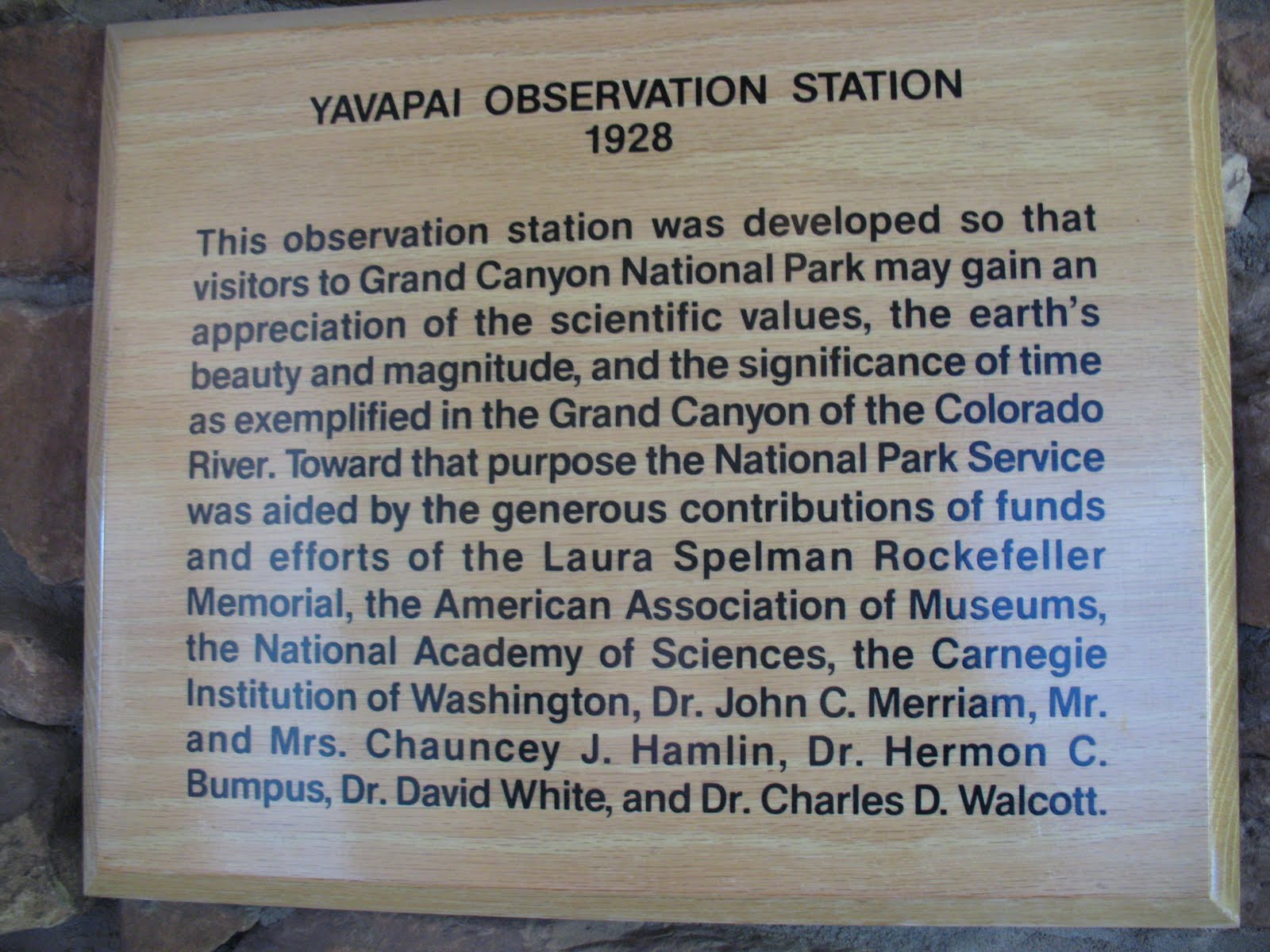
 The Yavapai Geology Museum is the largest of the museums we visited here.Originally an observation station, it still features a back wall devoted to views of the Grand Canyon.  In 2007, the building was opened as a museum dedicated to geology.  Visual and interactive exhibits explain geological formations and the concept of "deep time" to help visitors understand the magnitude of the time it takes for geological formations to develop and change.

Cutaway view of the South Rim wall
Another exhibit covers the contributions of scientists and naturalists who explored and studied the geology of the area.  The central exhibit, the geological wall, seems to be featured in all the news stories and reviews of the museum.  Visitors can look at the cutaway representation of the geological layers from several different angles to get a clearer understanding of how the walls of the canyon were formed.  

One of the observation windows features a quotation from President Theodore Roosevelt etched in the glass:

"Do nothing to mar its grandeur, for the ages have been at work upon it.  Keep it for your children, your children's children, and all who come after you."

The Yavapai Geology museum is open daily 8:00 a.m. – 7:00 p.m.

Does the Smithsonian have the right to charge for use of its images?

Currently, the Smithsonian (which celebrated its 165th birthday on August 10th) charges fees for any reproduction or use of  images from its collections.  Carl Malamud of Sebastapol, CA, argues that it doesn't have the authority to do so, since government agencies are not allowed to copyright work produced with public money.

Malamud thinks Americans should have similarly free access to reproduce, alter and distribute public-domain images found in the Smithsonian's collection.

“They have these wonderful collections that any teacher should be able to use, or any filmmaker, or any small business,” he said. “It would help spur education, economic activity, and it's just the right thing to do.”

So Malamud went to Washington last week where he met with lawmakers to discuss the issue.

 Teachers and students are among those expected to pay  for using images from the Smithsonian collection for reports and class plans.  If Malamud succeeds, the images will be available free of charge for everyone.