About this blog . . .

This blog is about 80% journal, 20% review. These posts may describe very recent visits or visits taking place in the last 3 or 4 years--please feel free to update or correct any of my information in the comments or through an email message.

Sunday, October 17, 2010

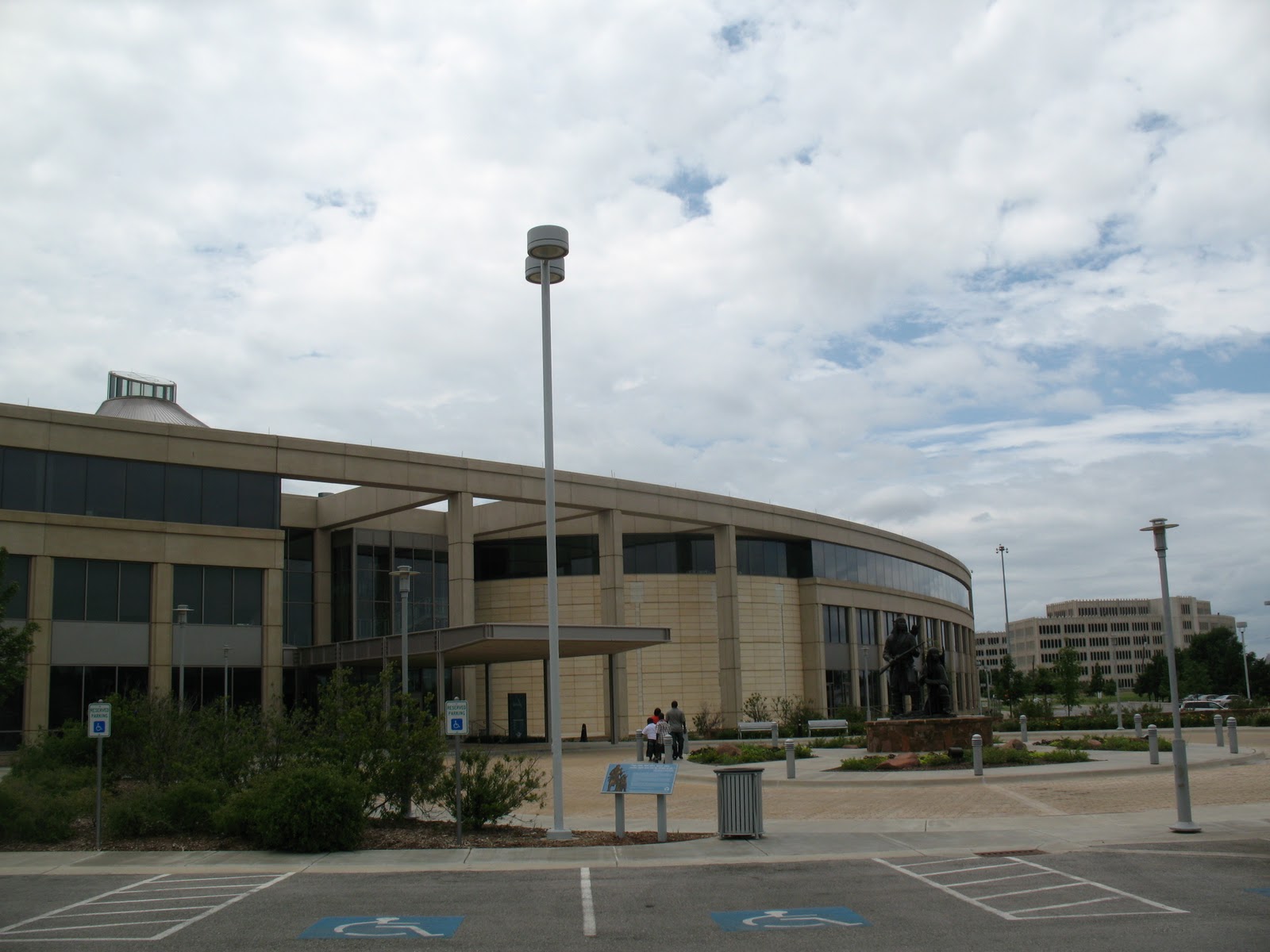
Oklahoma History Center, Oklahoma City

The Oklahoma History Center, opened in 2005, is a beautiful, still sparkling-new museum. State museums generally have a lot of ground to cover, and have to face the challenges of what to include and how to organize and display the wide range of available material.  Exhibits here range from the very popular "Another Hot Oklahoma Night: A Rock & Roll Exhibit" to exhibits on Oklahoma cartoonists, Native American tribes, kitchens, and aeronautics.


It's really a full-day experience, or perhaps a 2 half-day project.  For tourists trying to see everything in one several-hour visit, the range can be overwhelming.  I could have spent an entire visit in the arts and entertainment section, which started with the guitar display at the entrance and led to a full room on the rock/country exhibit "Another Hot Oklahoma Night," with a huge range of Oklahoma-based acts, including instruments, costumes, posters, and a section set up to look like a 70's college dorm room.  Life sized posters outside featured Woody Guthrie, Charlie Christian, and Bob Wills, and one of the first acts featured inside is Wanda Jackson,  reflecting the local Oklahoma influence on popular music. Newer music makes an appearance as well--The Flaming Lips are one of the modern bands with a presence here.


Broader cultural exhibits include an extensive walk-through the century section, with fashions and fads from the 20th century (I had forgotten all about the new-fangled Trimline phones of the 70s!) and samples of kitchen decor and appliances in bygone years.


A replica of the Winnie May highlights the aeronautics section, and provides a stunning foreground for a shot of the Oklahoma State Capitol.  There is also a cute little cafe here decorated with old-fashioned luggage--another memory trigger.  See if you can find the classic Samsonite design your parents took on their honeymoon!

Extensive historical exhibits on Oklahoma politics, African-Americans in Oklahoma, and Native American tribes could take several hours to absorb on their own.  And, like many other state museums, the History Center has exhibits on prominent native citizens in the military.  If you're traveling, then, you might want to consider either choosing an area and focusing your time (perhaps on one of the subjects you can't find in other museums) or allotting  a couple of 2-3 hour visits.  Give yourself time to look around outside as well; the exhibits continue with a scaled Red River path outside,and models of working oil derricks, reflecting the influence of the oil industry in Oklahoma's history.


The gift shop is definitely worth a look as well--a large selection of original, location-specific t-shirts, lots of children's gifts.


From the website:

Oklahoma History Center                                      Museum Hours             
800 Nazih Zuhdi Drive                                              
Monday - Saturday 10:00 a.m. to 5:00 p.m.
Oklahoma City, OK 73105                                        
Closed: Sundays, New Year’s Day, Thanksgiving Day, Christmas Day
405-522-0765


Admission

Adults: $7
Seniors ( 62+): $5
Students: $4
Children (5 & Under): Free
Family: $18.00
Veterans and Active Duty Military: Free            OHS Members: Free
Group Rate (10+): $5 per person
Discounts for OMA, AAM, Time Travelers network, Smithsonian Institute and Affiliate Members


Sunday, October 3, 2010

Old State House Museum, Little Rock

The Old State House Museum occupies the former State House for Arkansas.  The use of an historical building (as opposed to the new, modern buildings created for other state history museums, such as North Carolina's and Oklahoma's) offers some advantages.  To begin with, the site is beautiful.  Visitors can admire the historical building itself, rather than relying on pictures or models.  There is also a certain privilege involved in sitting in and occupying the rooms where history happened.   Of course, there are some trade-offs.  Rooms have to be re-imagined from their original purpose to accommodate displays and lines of visitor traffic.  Rather than the stunning, open great room that newer museums have as an entrance, the Arkansas History Museum has a hallway followed by the admission desk.

Once inside, the museum has the more intimate feeling that one would expect from a well-used historical building.  Exhibits spread across several rooms explore the history of the State House itself, and the dedicated women who protected and preserved it.  At one point, the building housed a medical school, and artifacts and photographs highlight the use of the building and the state of medicine during its use in that capacity. Another room features memorabilia from Bill Clinton's years as governor and from his campaign for the presidency. Visitors can also view--and sit in--the room used by state legislatures in earlier years.

The museum also explores the state's ambiguous reputation.  A permanent exhibit titled "Arkansas/Arkinsaw: A State and its Reputation" takes an interesting look, as their website notes, at  "the early development of a dual image, with Arkansawyers being portrayed as coarse, illiterate, and violent backwoodsmen on one hand, while also lifted up as noble frontiersmen – independent, honest, and humble."  Cartoons, quotations, and artifacts--such as Grandpa Jones' banjo--explore, explain, and question the image of the Ozark Hillbilly.  I found this the most interesting part of the museum, since it looked at this material with a sense of humor even as it considered the perhaps more serious implications of the hillbilly stereotype.

Information from museum website:

Admission is FREE
Open 9:00 a.m. to 5:00 p.m. Monday-Saturday; 1:00 to 5:00 p.m. on Sunday;
Closed Thanksgiving, Christmas Eve, Christmas, & New Years Day

Location & Directions
The museum is located at 300 W. Markham, situated between the DoubleTree and Peabody Hotels.


Thursday, September 16, 2010

Levine Museum of the New South, Charlotte

The "New South" in the museum's title reflects the economic and social gains of the South in the 20th century.  As Edward Rothstein points out in his review of the Levine Museum in the New York Times,
It is unlikely that anything resembling the impressive Levine Museum of the New South would exist anywhere else. A museum of the New North or the New East would be merely peculiar, but here the term “New South” has a venerable heritage, recalling unrealized hopes and great expectations. There is also much at stake in trying to understand just what the term really means.
 This museum followed a trend throughout the South of looking into and even confronting the past of the "Old South."  The museum is divided into two main levels.  On the lower level, visitors experience a history museum with the theme of progress.  Agricultural exhibits on farm equipment and life as a tenant farmer show how far behind the Old South was in industry and economic power in the post Civil War-early 20th century era.  An exhibit on racist groups provides a fairly honest look at the Councils and Klans--costumes and other artifacts are displayed.  (In one interesting approach to displaying disturbing material, the museum covered a photograph of a lynching scene and offered a warning to visitors about the material.)

Other civil-rights era exhibits include the infamous Greensboro Lunch counter and a replica of a school bus used for integration.  Television monitors in this area replay key news broadcasts from the era, awakening memories for those who lived through the events and making it more immediate for younger viewers.

Much of the museum also focuses on agriculture, industry, and economy in the South.  A brief film near the entrance narrates the progression from farming to industries (primarily textiles) to banking (although the film may need updating in light of the recent financial crisis).  My own family found the replica of milltown housing---an integral element in the textile industry's economy-- fascinating.  My husband and son played a game of bottlecap checkers there, and my daughter explored the kitchen cabinets and the wood stove.  My own interest reflected something more personal; my mother spent her earliest years in a house and a kitchen much like this one, in a small town in North Carolina in the 1930s.

  At the top level, the museum transforms from a historical/cultural experience to a tolerance museum.  These are interactive exhibits, offering visitors the chance to try on different clothes, respond to situations, and question their assumptions about other people.  One exhibit, for example, displayed pictures of individuals who might be easily stereotyped, then invited viewers to open a panel to reveal surprising or unexpected information about each person.

Rothstein mentioned that, until recent budget cuts, a Levine field trip had been a required part of  North Carolina's 8th grade curriculum.  I'll have to say that I hope those funds are restored soon; the museum offers a thoughtful, well-organized educational experience for all visitors, but it would seem particularly appropriate for upper-elementary and middle school students who are ready for this material and who need to move beyond a textbook to appreciate it fully.


Information from website:

Admission
Adults $6.00
Seniors (62+) and Students $5.00
Children (6-18) $5.00
Family $17.00
Under 6 free
Groups* $4.00
*10 or more, with advance reservation


Hours
Monday - Saturday:  10:00 a.m. - 5:00 p.m.
Sunday:  12:00 p.m. - 5:00 p.m.
Closed Easter Sunday, Memorial Day, Fourth of July, Labor Day, Thanksgiving Day, Christmas Eve, Christmas Day, and New Year's Day.

Parking
On weekdays, Levine Museum provides visitors 2 hours of validation for parking in Seventh Street Station parking deck, which is located next to the museum. After 2 hours, regular parking fees apply.
On weekends and for evening events, the museum provides parking validation, with no hourly limit.
Visitors should present parking ticket for validation at the Guest Services desk upon arrival.

Saturday, September 4, 2010

Scott Joplin House State Historic Park

The Scott Joplin House  seems to be a museum in progress.  Joplin lived here for only a few years, early in his first marriage.  The museum is working on furnishing and decorating with period household goods.  The exhibit on the main floor, in fact, explains that few of Joplin's belongings are available, and describes how they are trying to locate and refurbish items that accurately reflect the era--according to the website, 1902.  Copies of Joplin's sheet music and other memorabilia decorate the walls.

The museum experience begins with a film on Joplin's life, which we found informative--if a bit too long.  A guide escorts visitors upstairs, where they can see a re-creation of the bedrooms.  One room holds a period piano.  Back downstairs, the guide takes requests for the player piano.

I would like to visit this museum again in 5 or 6 years, just because I think there is a potential there for much more, and it hasn't quite been achieved yet.  The introductory video, for example, could be edited to cut about 10 minutes.  The guides, while friendly and informative, could be more helpful with a little more background knowledge about the music.  Also, according to one of the brochures available, the museum is associated with The Rosebud Cafe, a performance venue for Joplin's works, including his opera Treemonisha.  I'm hoping that soon the connection will be made more explicit, and visitors will be offered more assistance in combining the museum with the performance.


Update, 30 March 11--The museum has updated its website, and has a new video with a tour preview and information about the Rosebud Cafe, which is available to rent for performances or events.


Info from website:

2658A Delmar
St. Louis, MO 63103
314-340-5790

Hours:

Summer Hours (On-Season)
  • March through October - 10 a.m. to 4 p.m., Monday through Saturday (closed Sunday)
Winter Hours (Off-Season)
  • November through January - Closed
  • February - 10 a.m. to 4 p.m., Tuesday through Saturday (closed Sunday and Monday)
Tours are offered every hour.

Tour Prices:

Adults: $4.00
Children 6-12: $2.50
Under 6: Free

Group Rates (15 or more; reserve 1 week in advance @ 314-340-5790):  
Adults:  $3.00
Children 6-12: $1.50


Thursday, August 19, 2010

Interesting article in WSJ

The Wall Street Journal has an article on how museums study visitors to evaluate the appeal of their exhibits. 

 In "The Museum is Watching You: Galleries Quietly Study What People Like, or Skip, to Decide What Hangs Where,"  Isaac Arnsdorf writes

More museums are paying to send stealth observers through their galleries. Based on what they see, the museums may rearrange art or rewrite the exhibit notes. Their efforts reflect the broader change in the mission of museums: It's no longer enough to hang artfully curated works. Museum exhibits are expected to be interactive and engaging. As well, many foundations and donors are requiring proof that their funding is well-spent, and the studies provide data to show a rise in traffic or exhibit engagement.
One sticking points seems to be the text that accompanies many exhibits.  Museums are working on making the text shorter and more visually appealing to visitors. Providing a narrative for an exhibit also seems to spike interest.

Monday, August 16, 2010

Oklahoma City National Memorial and Museum

The Oklahoma City Memorial shows just how wide the potential and purpose of the concept of "museum" can be.  Looking at the work and planning that went into this museum, we can also see how difficult it must be to put an event like the OKC bombing on display.

The Memorial Pool
The museum sits across from the public memorial--the black pool and the empty chairs.  Visitors are brought through a timeline of  the morning of the bombing, April 19, 1995.  Radio weathercasts and recollections of the early morning events and routine situate the visitor in the perspective of ordinary citizens before the bombing.  One exhibit re-creates a room where ordinary city business was being conducted, and plays a recording of the meeting that was taking place, complete with the sound of an explosion and shattering glass that interrupted it.  The rupture between the moments before the bomb and everything that has come after remains the dominant theme of the museum.  The pool sits between 2 markers, one representing the minute before the bombing, the other the minute afterward--with the pool itself as the enormous chasm between before and after.

Other exhibits cover the aftermath from various perspectives.  For example, a display of political cartoons recalls some of the reactions from across the country.  This exhibit also calls attention to the common assumption before Timothy McVeigh''s arrest that the bombing must have been a Muslim plot. As for McVeigh, pictures and a discussion of his trial and execution find just the right touch to convey information while avoiding sensationalism.  The focus stays on the victims, with personal artifacts recovered from the Murrah Building--eyeglasses, clothing, office equipment--and information on the fate of the owners. Several exhibits also commemorate those who helped, from first responders to those who worked with survivors to other cities and groups that offered support in the aftermath.  Visitors also have the opportunity to listen to the words of survivors and witnesses in private cubicles. 

One considerate touch--boxes of tissues placed discretely through many of the exhibits--showed how deeply visitors were affected.  Another welcome, considerate touch was the exhibit on Judge Alfred P. Murrah, for whom the building was named. 

Survivor Tree
The museum achieves at least two goals--memorializing the victims (and the pre-bombing version of OKC itself), and learning from the event.  The Survival Tree just outside the museum serves as a logo and symbol of the mission to provide comfort and hope.  The website recommends allowing 1 1/2 hours for the visit; I believe our visit was closer to 2 hours.  We had 10 and 12 year old children with us, which meant lots of explaining and questions. 

Info from the website:

620 N. Harvey, Oklahoma City
405.235.3313 888.542.HOPE


Open Mon-Sat 9:00-6:00
Sunday 1:00-6:00  (except Memorial Day-Labor Day--12:00-6:00)


Adult $10
Senior (62+) $8
Military (With ID) $8
Student (6-17 or college student with current ID) $8
Children (5 years and under) Free

Friday, August 13, 2010

Louisville Slugger Museum & Factory

The Louisville Slugger Museum & Factory is a pleasant walk from Louisville's Convention Center and surrounding hotels.  I visited the Museum in March of 2010, and the website boasts of some recently finished updates, so there may be more now than what I saw a few months ago.

I was able to go on a factory tour, which I would definitely recommend.  Sign up for a tour at the front desk as soon as you get there--or you may be able to stop in before your visit and sign up.   The guide was friendly and quick with the expected jokes--great personality for the setting and subject.  In addition to seeing how bats were made, we had a chance to see some of the bats made for specific players, and learned about some of the more interesting special requests.  Be sure to ask for some free "nubs."

A video--I believe it was called "The Crack of the Bat"--showcased some of the famous hits delivered by Louisville Sluggers.  Nothing new, but baseball fans will always enjoy seeing some of the great moments of the game (note, however, that only Louisville Slugger hits are included, which explains why a handful of memorable hits don't appear there.)


Exhibits include one of Babe Ruth's bats, complete with his home run notches.  Visitors have a chance to try their hands at hitting a simulation of a major league fastball.  Timelines chronicle the history of baseball and of the Louisville factory.  Give yourself about 1 1/2 to 2 hours to do the tour, visit the exhibits, and see the video.
 
The gift shop here has one of the better selections of t-shirts--all colors, all sizes.  This would be a good place to pick up fairly unique shirts for the folks on your gift list.  Their featured item is a personalized mini-bat; if you want one, be sure to order it before you start the tour and visit, since it takes a while to produce.

Info from the website:

$10 - Adults (13-59)
$  9 - Seniors (60+)
$  5 - Kids (6-12)
Kids 5 and younger free

 
Open 9-6 daily, 12-6 during summer, 9-5 and 12-5 rest of the year; closed major holidays.

Historic Voodoo Museum, New Orleans LA

The Historic Voodoo Museum in New Orleans was a great way to begin our NOLA visit in March of 2008.  We arrived in New Orleans after a delayed flight, suffering from jet lag and lack of sleep.  This was an easy, low-key way to begin immersing ourselves in the New Orleans atmosphere.

Photo from museum website
Visitors should know going in that this is not a traditional, formal museum.  I noticed that commenters on some travel sites complained that there wasn't much to the museum, that it was just a few rooms with artifacts and pictures.  My reaction was that this observation was, strictly speaking, accurate, but that the intimate setting was appropriate for this collection.  The entry area--which doubled as the gift shop--was a small foyer; the exhibits began on a hallway, with photos and pictures of people and places relevant to Voodoo in New Orleans.  The exhibit rooms--I believe there were 3--contained artifacts and information related to Voodoo.  There was some interactivity (no, you don't get to put voodoo curses on people!) with a wishing tree in the last room  My 8 year old daughter enjoyed writing down a wish and putting in in the tree.

So, it's relatively inexpensive, short, and focused.  It will give you some of the background and atmosphere to understand voodoo references you might see or read about later in New Orleans.  If this sort of experience is what you're looking for, stop in.  You know you'll be in the French Quarter anyway!


Info from website:

724 Rue Domaine
New Orleans, LA 70116
(504) 860-0128

7 days, 10:00-6:00 (or later--not sure what that means!)
$7.00 General Admission
$5.50 Seniors, Military, College Students
$4.50 High School Students
$3.50 Under Age 12